Fire Trucks vs. Fire Suppression: Who to Call for Industrial Compliance
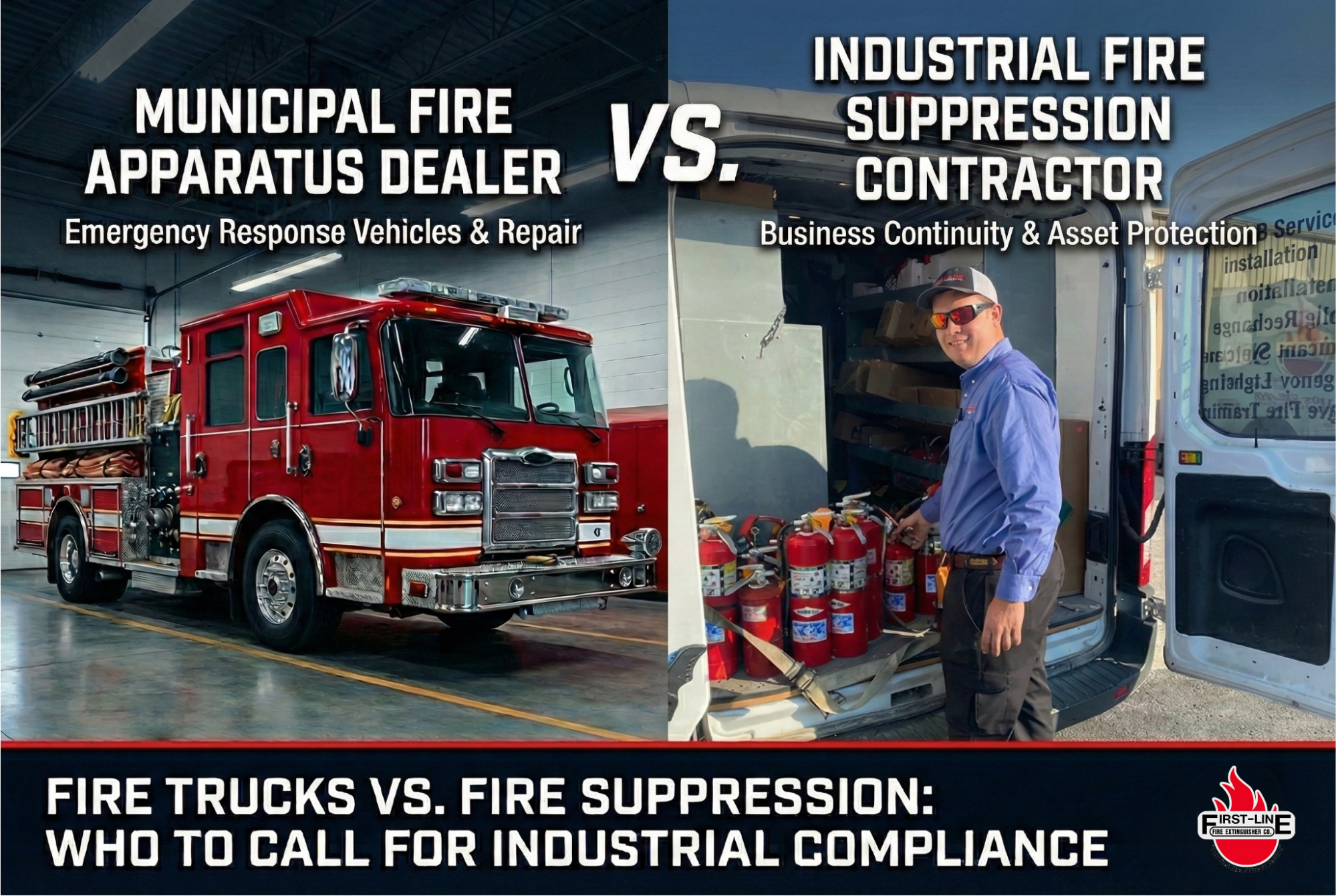
If you’re searching for "fire protection" on Google, you might be looking for two very different things.
Are you a municipal fire chief looking to repair the pump on a $800,000 fire engine? Or are you a mine superintendent in Western Kentucky trying to stop a $2 million haul truck from burning down in the middle of a shift?
Because those are two different industries.
At First-Line Fire Extinguisher Co., we get calls for both. And while we respect our friends in the apparatus business, we want to make sure you get the help you actually need without wasting time on the phone.
Here is the definitive guide to the difference between Fire Apparatus Dealers and Industrial Fire Suppression Contractors—and why knowing the difference matters for your safety compliance in 2026.
The Industry Mix-Up: A Quick Guide
For those skimming for a phone number, check this table first to find who you need.
| If you need... | You need to call... |
|---|---|
| Fixed Fire Systems (Kitchen hoods, Paint booths, CNC machines) | First-Line Fire |
| Heavy Equipment Suppression (Mining dozers, Excavators) | First-Line Fire |
| Marine/River Safety (Towboat CO2 systems, Subchapter M audits) | First-Line Fire |
| Fire Truck Repair (Engine service, Chassis work) | Municipal Fire Apparatus Dealer |
| Ambulance Sales (New emergency vehicles) | Emergency Vehicle Dealership |
We are the experts in asset protection. We don't sell the trucks that drive to the fire; we install the systems that put the fire out before the truck ever needs to leave the station.
Need industrial fire suppression right now?
Stop worrying about compliance and start protecting your assets.
Click here to Request a Quote or call us at (270) 554-3473.
What Is an Industrial Fire Suppression Contractor?
Unlike a fire truck dealer, who serves municipal fire departments, an industrial fire suppression contractor serves business owners and facility managers.
Our job isn't just "putting out fires"—it's Business Continuity.
In industries like the River Industry or Mining, a fire doesn't just mean safety reports; it means downtime. And in 2026, downtime is the most expensive cost on your balance sheet. A barge stuck at a terminal because of a red-tagged extinguisher costs thousands of dollars an hour. A dozer burning on a highwall can shut down production for weeks.
Here is exactly what we handle at First-Line Fire:
1. Heavy Equipment & Vehicle Suppression
If you operate heavy machinery—whether it’s in a coal mine in Madisonville or a limestone quarry in Southern Indiana—your insurance likely requires an automatic fire suppression system.
We are a distributor for AFEX and ANSUL Fire Suppression Systems. These aren't simple extinguishers strapped to the bumper; they are complex, dual-agent systems integrated into the vehicle’s engine block and hydraulics.
The Risk: A ruptured hydraulic line spraying fluid onto a superheated turbocharger.
Our Solution: Automatic sensors detect the heat, shut down the engine, and flood the compartment with dry chemical and liquid cooling agents.
Why You Call Us: Because a fire truck can’t drive into an underground mine. Your equipment needs to protect itself.
2. Marine & River Industry Safety
Paducah is the hub of the inland waterways, and we have spent decades keeping towboats and barges compliant with USCG Subchapter M regulations.
The marine environment is brutal on equipment. Vibration, humidity, and confined spaces mean that standard office-building safety gear will fail. 18 We provide specialized marine suppression systems designed to withstand life on the river. With the IMO 2026 ban on PFOS foams taking effect this year, we are also leading the charge in retrofitting vessels to new Fluorine-Free Foam (F3) standards.
3. Commercial Compliance (Restaurants & Industry)
Every commercial kitchen needs a UL-300 compliant hood system. Every paint booth needs an industrial dry chemical system. We design, install, and—most importantly—maintain these systems.
Many of our clients start with us for simple portable extinguisher inspections and realize we can handle their emergency lighting and suppression systems, too.
Why You Shouldn't Call a Fire Truck Dealer for Industrial Hazards
There is often confusion because the terminology sounds similar. You might think, "I have a fire risk, I should call the fire truck people."
Here is why that doesn't work for industrial compliance.
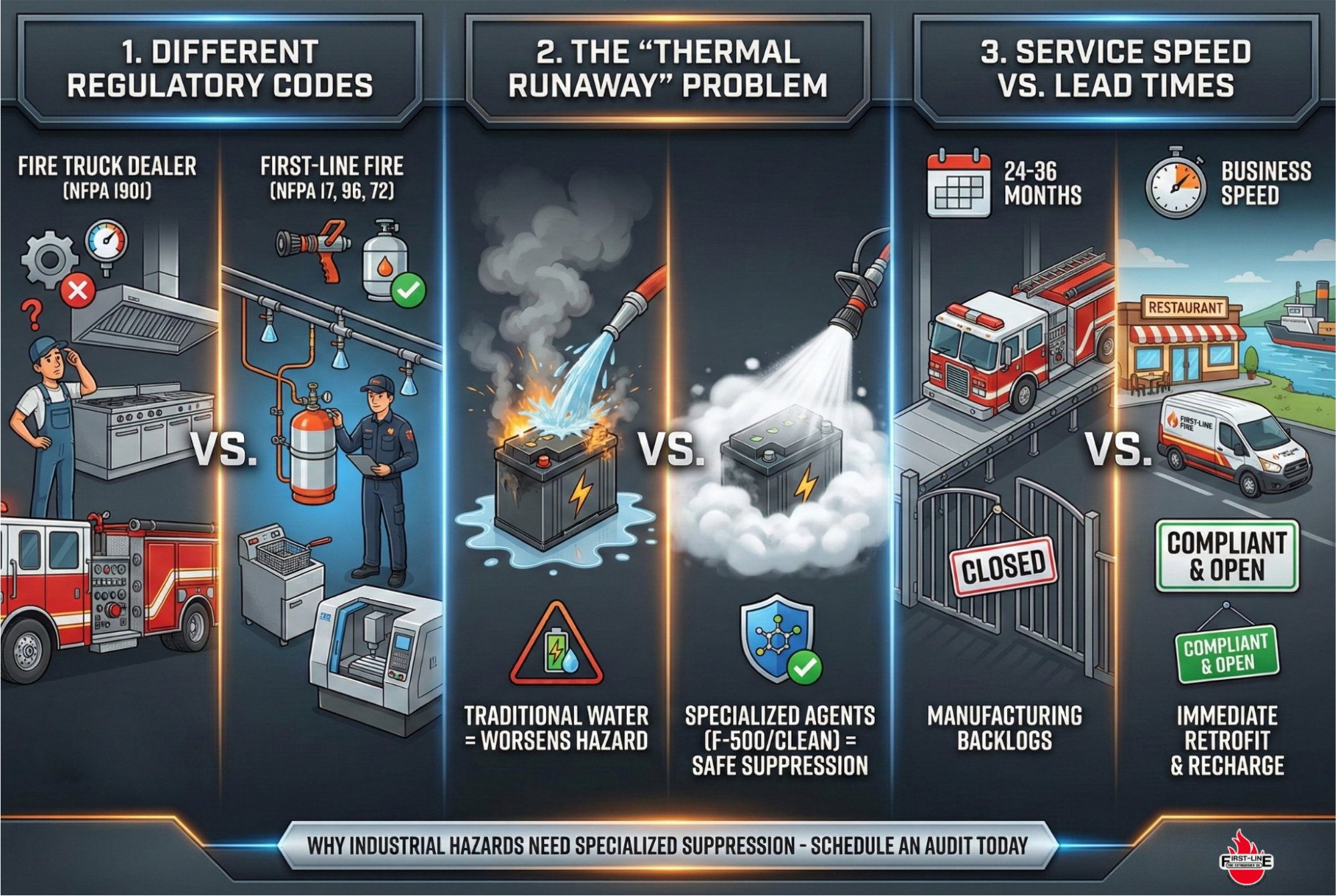
1. Different Regulatory Codes
Fire apparatus dealers live and breathe NFPA 1901 (Standard for Automotive Fire Apparatus). They worry about pump pressure, chassis weight, and siren decibels.
We live by NFPA 17, NFPA 96, and NFPA 72. We worry about nozzle coverage, flow points, and chemical agent shelf life. If you ask a truck mechanic to inspect your restaurant's Ansul system, they won't just be confused—they won't be licensed to touch it.
2. The "Thermal Runaway" Problem
Modern industrial risks are changing. In 2026, we are seeing more lithium-ion battery fires in manufacturing plants and power tools.
A traditional fire truck pumps water. But water can sometimes worsen a lithium battery fire or hazardous chemical spill.
We specialize in Encapsulator Agents (like F-500) and clean agents that suppress these high-tech fires without destroying your expensive electronics or causing an environmental hazmat disaster.
3. Service Speed vs. Manufacturing Lead Times
If you order a new fire truck today, you might wait 24 to 36 months for delivery due to global supply chain backlogs.
If you call First-Line Fire for a suppression system retrofit or an extinguisher recharge, we operate on business speed. We know you can't open your restaurant or launch your boat until the Fire Marshal signs off. Our goal is to get you compliant now, not in three years.
Is your facility overdue for an inspection?
Don't wait for the Fire Marshal to find a violation.
The 2026 Outlook: Why "Suppression" Matters More Than Ever
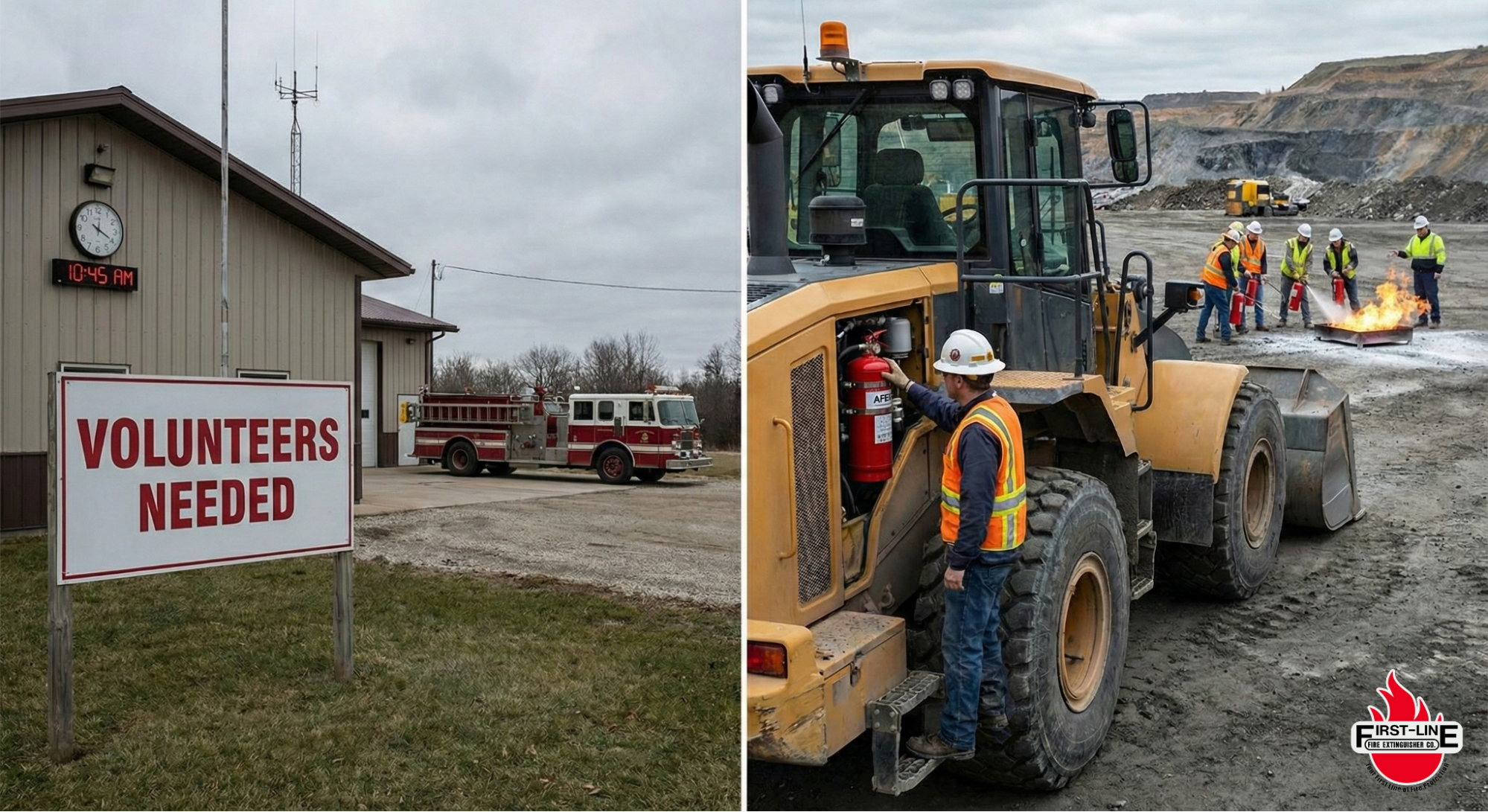
The landscape of fire safety is shifting rapidly. In 2026, reliance on municipal fire departments is becoming riskier for industrial sites.
Why? The Volunteer Crisis.
Volunteer fire departments across the U.S. are facing historic staffing shortages. Response times in rural areas—where many mines and river terminals are located—are increasing.
You can no longer assume that help is 10 minutes away.
This shift toward self-reliance means your on-site systems must work.
Your AFEX or Ansul system on that loader is your first line of defense.
Your marine CO2 system is the only thing standing between a small engine fire and a total vessel loss.
Your staff's training is critical. (That’s why we offer live-fire training classes where your team actually puts out real fires, not just watches a video).
Summary: Who Do You Need?
Call a Fire Apparatus Dealer if:
You are a Fire Chief buying a new E-One pumper.
You need warranty work on an ambulance chassis.
You need repairs on a municipal emergency vehicle.
Call First-Line Fire if:
You own a business, mine, or fleet in the Midwest/Mid-South.
You need to pass a Fire Marshal or USCG inspection.
You need fire extinguishers, hood systems, or vehicle suppression.
You want to prevent downtime and protect your capital assets.
We are proud of our name, and we are proud to be the "First Line" of defense for the industries that power our economy.
Frequently Asked Questions (FAQ)
Do you service fire trucks?
No. We service Vehicle Fire Suppression Systems (VFSS) installed on heavy equipment like mining trucks, dozers, and buses. 40We do not repair the mechanical engines or pumps of municipal fire trucks.
Can you help with the 2026 PFAS foam ban?
Yes. If you have legacy AFFF foam in your suppression systems, you are likely facing a compliance deadline this year. We can drain, dispose, and retrofit your hardware for the new Fluorine-Free Foams (F3) required by the EPA and IMO.
What areas do you serve?
We are headquartered in Paducah, KY, with operations in Madisonville, KY and Princeton, IN. We cover the entire mid-South and Midwest region for major industrial projects.
Do you sell replacement parts for municipal fire trucks (like pumps, sirens, or chassis)?
No, we do not. If you need parts for an E-One, Pierce, or Rosenbauer apparatus, you need to contact a licensed fire apparatus dealer. We specialize in installed suppression systems that protect the facility or the vehicle itself—not the emergency truck that responds to the scene.
How often does my AFEX or Ansul mining fire suppression system need inspection?
For heavy equipment in harsh environments (like coal mines or quarries), rigorous maintenance is critical. Insurance underwriters often mandate specific inspection intervals, typically semi-annually or quarterly depending on the risk assessment. We perform these inspections on-site to ensure your dual-agent systems are ready to handle a thermal event.
Learn more about our Vehicle Fire Suppression Services.
What is the best way to put out a lithium-ion battery fire in a factory?
Standard ABC dry chemical extinguishers are generally ineffective against the "thermal runaway" of a lithium-ion battery, as these fires generate their own oxygen. For 2026 compliance, we recommend specialized Encapsulator Agents (like F-500) or specific clean agent systems designed for battery storage areas.
Read our full guide: "How to Put Out a Lithium Battery Fire".
Is my AFFF firefighting foam illegal to use in 2026?
It depends on your industry, but regulations are tightening rapidly. The IMO SOLAS ban on PFOS-containing foams is effective January 1, 2026 for marine vessels. Additionally, strict EPA reporting requirements and state-level bans are forcing many industrial clients to transition to Fluorine-Free Foam (F3) immediately.
Don't wait: You cannot just "top off" your old tank with new foam. The system must be drained and Triple-Rinsed to avoid contamination liability.
Does First-Line Fire perform Subchapter M fire safety audits for towboats?
Yes. We are specialists in the River Industry and understand the unique requirements of 46 CFR Subchapter M. We provide the fire suppression installation, maintenance, and documentation you need for your Towing Safety Management System (TSMS) audits.
See our River Industry capabilities here.
Who fixes commercial kitchen fire systems in Western Kentucky?
We do. Whether you are in Paducah, Madisonville, or Princeton, IN, we install and service UL 300 compliant kitchen hood suppression systems. We also inspect the emergency exit lighting and portable extinguishers required for your Fire Marshal inspection.
Ready to secure your assets?
Protecting your business is about more than just meeting code—it's about ensuring you can keep working tomorrow.
Contact First-Line Fire for a free consultation on your facility's fire safety needs.