Wet Chemical vs. Dry Chemical Fire Suppression: Which Does Your Business Need?
Quick Answer
Wet chemical fire suppression systems are designed for commercial kitchens and use a potassium-based liquid agent that reacts with cooking oils to smother grease fires (Class K). Dry chemical fire suppression systems use a powder agent (typically sodium bicarbonate, potassium bicarbonate, or monoammonium phosphate) and are designed for industrial environments protecting against Class A, B, and C fires involving combustibles, flammable liquids, and electrical equipment.
The right system depends on what you're protecting: if you operate a kitchen with deep fryers and grease, you need wet chemical. If you have a paint booth, fuel storage area, or industrial processing equipment, you need dry chemical.
The Core Difference at a Glance
| Feature | Wet Chemical | Dry Chemical |
|---|---|---|
| Primary Use | Commercial kitchens | Industrial facilities, vehicle protection, fuel storage |
| Fire Class Rating | Class K (cooking oils/fats) | Class A, B, and C |
| Suppression Agent | Potassium-based liquid (potassium acetate, citrate, or carbonate) | Sodium bicarbonate, potassium bicarbonate (Purple K), or monoammonium phosphate (ABC) |
| How It Works | Creates a foam blanket through saponification | Smothers fire and interrupts chemical reaction |
| Residue | Soapy liquid; cleanable but messy | Fine powder; corrosive and difficult to clean |
| Best For | Deep fryers, grills, woks, char broilers | Paint booths, generators, industrial vehicles, flammable liquid storage |
| NFPA Standard | NFPA 96, NFPA 17A | NFPA 17 |
| Inspection Frequency | Every 6 months | Every 6 months (annual at minimum) |
What Is a Wet Chemical Fire Suppression System?
A wet chemical fire suppression system is a specialized fire protection solution engineered specifically for commercial cooking environments. When activated, it discharges a fine mist of potassium-based liquid agent directly onto the burning surface.
How Wet Chemical Systems Work
Wet chemical systems suppress fires through a process called saponification. When the alkaline potassium agent contacts hot cooking oils or fats, it triggers a chemical reaction that converts the burning oil into a thick, soap-like foam. This foam blanket accomplishes three things simultaneously:
Smothers the fire by cutting off oxygen
Cools the cooking surface below its auto-ignition temperature
Prevents re-flash by sealing the fuel source under a stable foam layer
This last point is critical. Cooking oil fires can reach temperatures exceeding 700°F, well above the auto-ignition point of vegetable oils. Without a system that prevents re-flash, fires can reignite even after appearing extinguished.
Where Wet Chemical Systems Are Required
Per NFPA 96, wet chemical systems are mandatory protection for:
Restaurant kitchens with deep fryers, ranges, griddles, or char broilers
Cafeteria and institutional cooking in schools, hospitals, and corporate facilities
Food trucks and mobile cooking operations
Hotel kitchens and catering facilities
Bakery and donut shop fryers
The system protects the cooking appliances, the hood and duct system, and the plenum area where grease accumulates.
Components of a Wet Chemical System
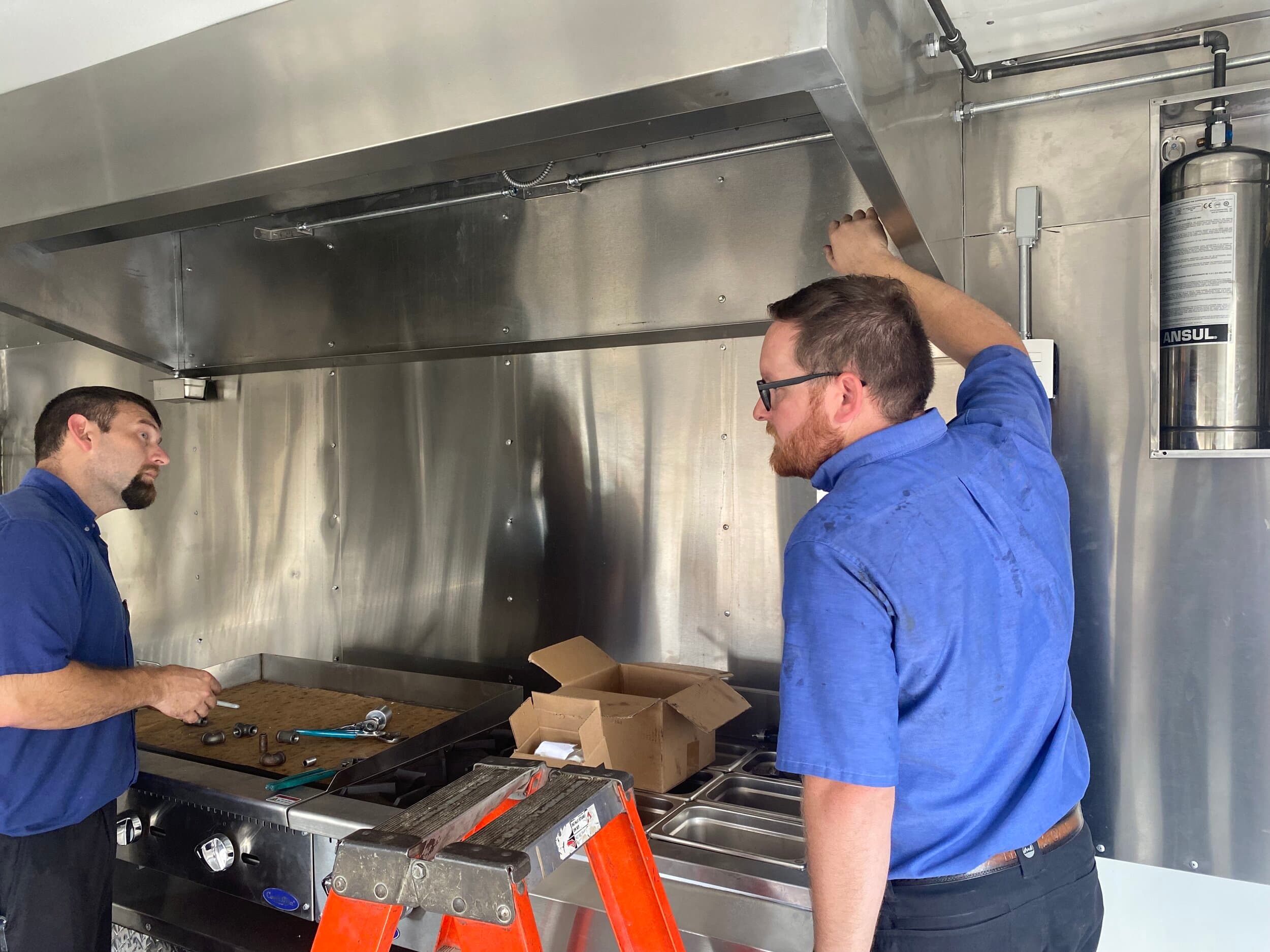
A typical commercial kitchen wet chemical system includes:
Agent storage tank mounted on the wall or in a cabinet
Discharge nozzles strategically placed over each appliance and inside the duct
Fusible link detection that activates automatically when temperatures exceed safe thresholds
Manual pull station for human override at a marked exit
Gas shut-off valve that automatically cuts fuel supply during activation
Alarm interconnection to notify staff and monitoring services
What Is a Dry Chemical Fire Suppression System?
A dry chemical fire suppression system uses a finely powdered extinguishing agent stored under pressure and discharged through nozzles to suppress fires across multiple hazard classes. These systems are engineered for environments where water-based suppression would be ineffective, dangerous, or impractical.
How Dry Chemical Systems Work
Dry chemical agents suppress fire through three simultaneous mechanisms:
Chemical interruption — The powder breaks the combustion chain reaction at a molecular level
Smothering — The dense cloud of particles displaces oxygen at the fuel source
Cooling — The agent absorbs heat as it disperses across the burning material
The result is rapid knockdown, often within seconds of activation.
Types of Dry Chemical Agents
Not all dry chemicals are the same. The three primary agents serve different applications:
Monoammonium Phosphate (ABC Powder)
Multi-purpose agent rated for Class A, B, and C fires
Most common in general industrial settings
Leaves a sticky, corrosive residue on hot surfaces
Sodium Bicarbonate (Regular Dry Chemical)
Rated for Class B and C fires
Effective on flammable liquid and electrical fires
Less corrosive than ABC, easier cleanup
Potassium Bicarbonate (Purple K)
Rated for Class B and C fires
4 to 5 times more effective than sodium bicarbonate on flammable liquids
Standard for petroleum, paint, and high-hazard applications
Where Dry Chemical Systems Are Required
Dry chemical fire suppression is the standard for:
Paint spray booths in automotive and manufacturing facilities
Fuel storage and dispensing areas at fleet operations and gas stations
Industrial machinery including CNC machines and processing equipment
Heavy vehicles and construction equipment
Generator rooms and mechanical spaces
Aircraft hangars and aviation facilities
Marine engine rooms on tow boats and commercial vessels
Wet vs. Dry Chemical: Application by Industry
Choosing between systems often comes down to your industry and the specific hazards present. Here's how the decision typically breaks down.
Choose Wet Chemical If You Operate
A restaurant, commercial kitchen, food service operation, hotel, school cafeteria, hospital kitchen, catering company, or any facility with cooking equipment that produces grease-laden vapors. Per NFPA 96, you don't really have a choice here — wet chemical (or an equivalent UL 300 listed system) is the code requirement.
Choose Dry Chemical If You Operate
A manufacturing facility, automotive paint shop, fuel depot, marine vessel, construction site with heavy equipment, mining operation, power generation facility, chemical processing plant, or any environment where flammable liquids, electrical equipment, or industrial machinery present the primary fire risk.
When You Might Need Both
Larger facilities frequently require both system types in different areas. A hotel, for example, typically needs:
Wet chemical for the main kitchen and any additional food prep areas
Dry chemical (or clean agent) for generator rooms, mechanical spaces, and laundry facilities with industrial equipment
A manufacturing plant with an employee cafeteria has the same dual requirement.
Cost Comparison: Wet vs. Dry Chemical Systems
System costs vary substantially based on facility size, complexity, and local code requirements. General ranges look like this:
Wet Chemical Systems
Small restaurant (single cookline): $3,500 to $7,000 installed
Mid-size restaurant: $7,000 to $12,000 installed
Large commercial kitchen: $12,000 to $25,000+ installed
Semi-annual inspection: $150 to $400
Recharge after discharge: $400 to $800
Dry Chemical Systems
Small industrial application: $2,500 to $6,000 installed
Vehicle suppression (per vehicle): $3,000 to $8,000
Large industrial system: $10,000 to $50,000+ depending on coverage
Annual inspection: $150 to $500
Recharge after discharge: $500 to $1,500
These figures don't include design fees, permits, or building modifications that may be necessary.
Maintenance and Inspection Requirements
Both systems require professional service at least every six months per NFPA standards, but specific maintenance differs.
Wet Chemical System Maintenance
Per NFPA 96 and NFPA 17A:
Semi-annual inspection by a certified technician
Visual checks of nozzles, fusible links, and tank pressure
Fusible link replacement every 6 months (some jurisdictions require annual)
Hydrostatic testing of the agent tank every 12 years
Hood and duct cleaning at frequencies based on cooking volume (NFPA 96)
Dry Chemical System Maintenance
Per NFPA 17:
Semi-annual inspection by a certified technician
Agent inspection to verify it hasn't compacted or absorbed moisture
Pressure verification on all cylinders
Nozzle inspection to ensure protective caps are intact
6-year internal examination of cylinders
12-year hydrostatic testing of cylinders
A common pitfall with dry chemical systems is moisture absorption. The powder can clump if the storage cylinder seals fail, rendering the system non-functional even though it appears intact. Only a qualified technician can verify agent condition.
Pros and Cons of Each System
Wet Chemical Pros
Specifically engineered for grease fires that other agents cannot effectively suppress
Cooling action prevents dangerous re-flash
Cleanup is messy but non-toxic and water-soluble
Required by code for commercial cooking — there's no substitute
Effective even on high-temperature cooking surfaces
Wet Chemical Cons
Limited to Class K applications; ineffective on most other fire types
Higher upfront cost than basic dry chemical systems
Requires more nozzle precision in design and installation
Significant kitchen downtime after discharge for cleanup
Dry Chemical Pros
Versatile across multiple hazard classes (A, B, and C with ABC agent)
Rapid knockdown of flammable liquid fires
Lower cost than clean agent alternatives for similar industrial applications
Effective in outdoor and unconditioned environments
Long shelf life when properly maintained
Dry Chemical Cons
Powder residue is corrosive to electronics and sensitive equipment
Cleanup is extensive and can damage surfaces
Powder can compact or absorb moisture if not maintained properly
Reduces visibility during discharge, complicating evacuation
Not suitable for occupied spaces with sensitive electronic equipment (clean agents are better)
When to Consider Alternatives
Wet and dry chemical aren't the only options. Depending on your facility, alternatives may be more appropriate.
Clean Agent Systems (FM-200, Novec 1230, Inergen) are better when you need to protect sensitive electronic equipment, server rooms, telecommunications facilities, museums, or document archives. They leave no residue and don't damage equipment.
Foam Systems are typically used for large-volume flammable liquid storage like fuel depots and aircraft hangars where dry chemical alone wouldn't provide sufficient coverage.
CO2 Systems work for unoccupied spaces with electrical or flammable liquid hazards, but they're dangerous in occupied areas due to oxygen displacement.
Water Mist Systems are emerging as alternatives in some industrial applications, combining cooling and oxygen displacement without the residue issues of dry chemical.
A professional fire protection assessment will identify which system or combination provides the best protection for your specific operation.
How First-Line Fire Helps You Choose the Right System
Since 1984, First-Line Fire Extinguisher Co. has helped thousands of businesses across Kentucky, Indiana, Illinois, and Tennessee select, install, and maintain the right fire suppression systems for their unique operations. Our certified technicians conduct comprehensive facility assessments to identify your specific hazards and recommend the most appropriate suppression solution — whether that's wet chemical, dry chemical, clean agent, or a combination of systems.
Our pre-engineered fire suppression services include:
On-site facility assessment and hazard identification
Custom system design tailored to your operations and code requirements
Professional installation by certified technicians
Semi-annual and annual inspection programs to maintain compliance
Recharge services and emergency repairs
Staff training on proper system operation
Whether you operate a single restaurant in Paducah or a multi-site industrial operation across the Central US, we'll make sure your facility is protected and code-compliant.
Schedule your free fire suppression consultation today. Call us at (270) 279-1865 or contact your nearest First-Line Fire office.
Frequently Asked Questions
What's the main difference between wet and dry chemical fire suppression?
Wet chemical systems use a liquid potassium-based agent designed specifically for cooking oil and grease fires (Class K). Dry chemical systems use a powdered agent for industrial fires involving combustibles, flammable liquids, and electrical equipment (Class A, B, and C).
Can I use a dry chemical system in my restaurant kitchen?
No. NFPA 96 requires UL 300 listed wet chemical systems for commercial cooking equipment that produces grease-laden vapors. Dry chemical systems are ineffective at preventing re-flash on hot cooking oils and don't meet code for kitchen hood suppression.
How often does a wet chemical system need to be inspected?
Wet chemical systems require professional inspection every six months per NFPA 96 and NFPA 17A, plus daily visual checks by kitchen staff. Fusible links must be replaced semi-annually, and the agent tank requires hydrostatic testing every 12 years.
Is dry chemical residue dangerous?
Dry chemical residue is generally non-toxic but is corrosive to metals and damaging to electronics. Cleanup should begin immediately after a discharge to minimize damage to equipment and surfaces. ABC powder (monoammonium phosphate) is particularly corrosive when it contacts hot surfaces.
How much does a commercial kitchen wet chemical system cost?
A wet chemical system for a typical small to mid-sized restaurant kitchen costs between $3,500 and $12,000 installed, depending on the number of appliances, hood configuration, and local code requirements. Larger institutional kitchens can exceed $25,000.
Do wet chemical systems work on all kitchen fires?
Wet chemical systems are designed specifically for Class K cooking oil and grease fires. They are also effective on small Class A fires but should not be relied upon for electrical fires or flammable liquid fires outside the cooking environment.
Can dry chemical systems be used outdoors?
Yes. Dry chemical systems are well-suited for outdoor applications including fuel dispensing areas, vehicle suppression on construction equipment, and industrial machinery exposed to weather. The agent storage cylinders are designed to operate across a wide temperature range.
What happens if my fire suppression system discharges accidentally?
After any discharge — accidental or otherwise — the system must be professionally inspected and recharged before returning to service. The affected area also requires thorough cleaning. Notify your fire suppression service provider immediately to schedule an emergency recharge and inspection.
Are wet chemical and dry chemical systems required by law?
Yes, in most cases. NFPA 96 mandates wet chemical (or equivalent UL 300) systems for commercial cooking operations. NFPA 17 governs dry chemical system requirements. State and local fire codes typically adopt these NFPA standards, and OSHA requires appropriate fire protection in workplace environments.
Can I install a fire suppression system myself?
No. Both wet and dry chemical fire suppression systems must be designed, installed, and maintained by certified technicians. DIY installation will fail fire marshal inspection, void insurance coverage, and create serious safety risks. Professional installation is required by NFPA standards and local codes.