If you run a school, church, clinic, plant, dealership, or restaurant in Hopkinsville, your emergency lights have a test schedule. NFPA 101 sets it. There are two tests: a short one every 30 days and a long one once a year. Here’s what each one is, who does it, what to write down, and what usually goes wrong.
Why a light that looks fine can still fail
An emergency light runs on building power until the power goes out. Then it’s supposed to switch to its battery. A sign can look lit on building power and still have a dead battery. You won’t know until the lights go out, and that’s the worst time to find out.
The test is the only way to know. That’s why the schedule exists.
The 30-day test: your staff’s job
Every 30 days, each emergency light and lit exit sign gets a 30-second button test. Push and hold the test button. The unit should switch to battery and stay lit the whole time.
- Pass: it switches over and stays bright for the full 30 seconds.
- Fail: it doesn’t come on, it flickers, it goes dim, or it shuts off before the 30 seconds are up.
Your own staff can do this test, and they’re the ones who do it. We don’t come out monthly for it. Once someone knows where every unit is, it takes a few minutes per floor.
The hard part isn’t the test. It’s doing it every month. Who in your building owns that job? What happens to it when that person is out, or quits? Put one name on it and a backup name under it. Walk the building with them once so they know where every unit is, including the ones in back halls, stairwells, and storage rooms.
The yearly 90-minute test: our job
Once a year, every unit runs on battery for a full 90 minutes. That’s the test we do.
This test catches what the 30-day test can’t. A worn battery can hold a charge for 30 seconds and still give out long before 90 minutes. The 90-minute run shows whether it will last long enough to get people out of a dark building.
Plan for it. Ninety minutes on battery drains the units, so they need time to recharge before they’re ready again. Pick a day when the building is staffed and the power is on. We test your lights on the same calendar as your extinguishers, so one visit covers both. Your extinguishers are inspected and serviced on that same visit.
When we do the work, we don’t shut you down.
Your monthly log
The monthly log is yours. Keep it in the building, in one place, where the next manager can find it. When someone asks how you know the lights work, the log is your answer.
For each 30-day test, write down:
- The date.
- Which units were tested. Use a location for each one, like “north hall by the gym door” or “shop exit, east wall.”
- The result for each unit: pass or fail.
- What was fixed and when: new battery, new lamp, unit replaced.
- Who did the test.
A simple sheet works. List every unit down the side and the months across the top. Mark each box pass or fail. If a unit fails, write what was done about it and the date it was fixed. When the yearly 90-minute test is done, note the date and the results in the same place, so the whole year is together.
If your building changes, update the list. A remodel can add a unit or take one out. A unit that isn’t on the list doesn’t get tested.
Common failures and what happens next
Here’s what shows up when lights get tested:
- Dead or worn batteries. The unit looks fine on building power and goes dark on the test.
- Lamps that quit. The battery is good but a head or bulb won’t light.
- Units that don’t switch over. Power goes out and the unit stays dark, even though the battery has a charge.
- Damaged or missing units. Fixtures that were knocked loose, painted over, or taken down during a remodel.
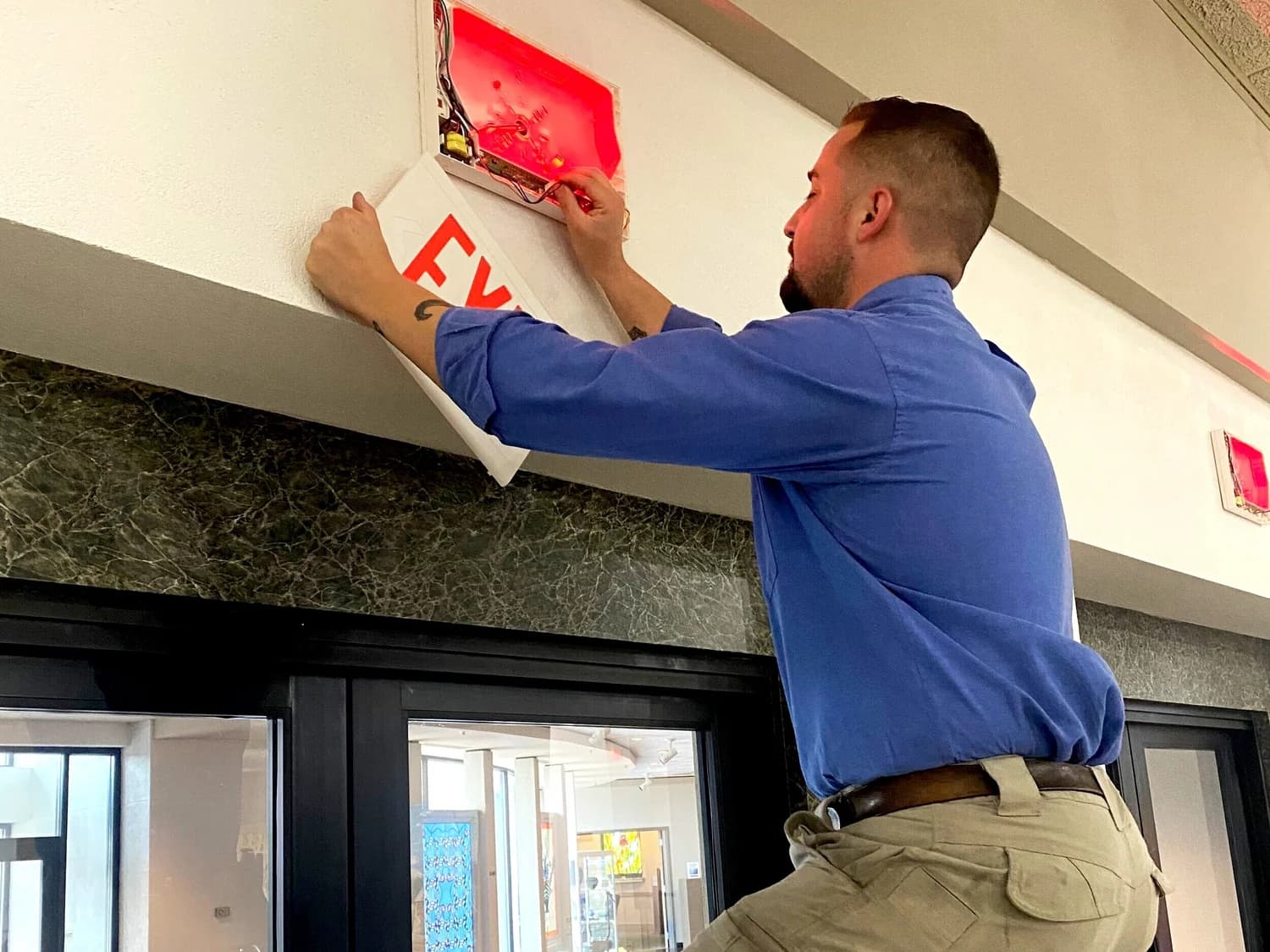
We replace batteries and lamps that quit. We install and replace exit and emergency lights, so if a unit can’t be fixed, we put in a new one. We sell LED exit signs. We also install self-testing units. They run their own monthly check and show you when something’s wrong, so your staff aren’t the only ones watching.
If your staff finds a failure on the monthly test, don’t wait for the yearly visit. Write it in the log and call us. If a required exit is dark, we offer 24-hour emergency service. Call 1-800-348-9604.
Which Hopkinsville buildings this applies to
If your building has required emergency lights, the schedule applies. Around Hopkinsville that includes:
- Schools and churches
- Clinics
- Manufacturing plants
- Grain and agribusiness operations
- Ag, equipment, and car dealers, body shops, and tire shops
- Restaurants
- Stores and offices
Exit signs with a battery backup get tested the same way, on the same 30-day and yearly schedule.
If the fire marshal is coming, the inspection checklist covers emergency lights and the rest of the walk-through. Kentucky’s code items are in which local code items must be on a fire marshal checklist.
Getting it done in Hopkinsville
Hopkinsville is served from our Madisonville shop, and our techs come to you. See our Hopkinsville page.
Our techs are certified and licensed. They come in a company truck and uniform. We’ve been in business since 1984, more than 40 years, and we’re members of NAFED and NFPA.
Your staff handles the 30-day test and the log. We handle the 90-minute test, the fixes, and the extinguishers on the same visit. We keep up with the date.
Want your emergency lights tested? See exit and emergency light service or call 1-800-348-9604. Tell us where the building is and how many lights you have.