
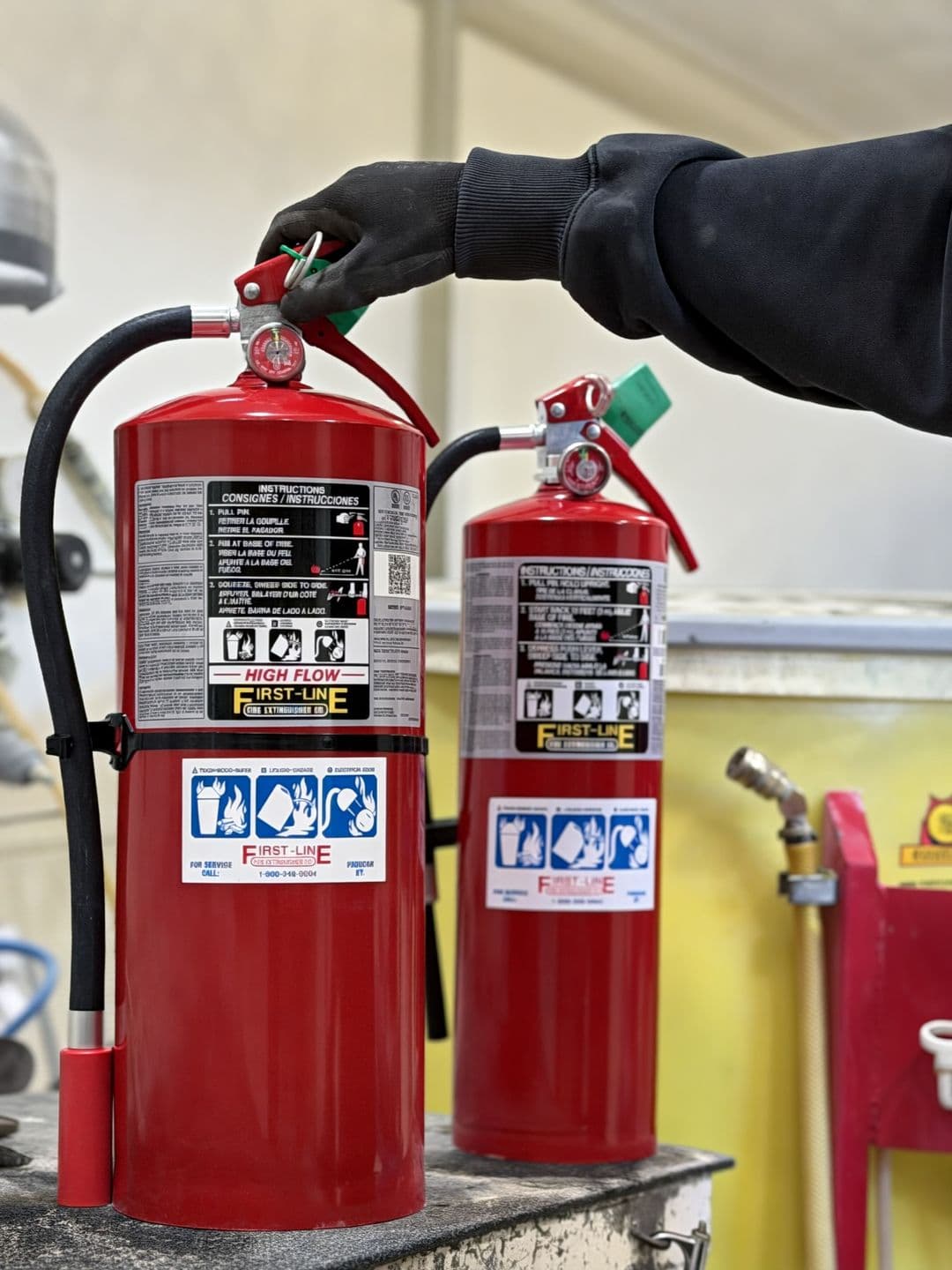
It's one of the first questions we get from Owensboro businesses, and it usually comes up right before a new building opens, right after an inspection, or when somebody in charge of a big building realizes nobody really knows why the extinguishers are where they are. There isn't one number that fits every building. The count comes out of three things: what could burn, how the building is laid out, and how far somebody would have to walk to reach an extinguisher.
NFPA 10, the national extinguisher standard, gives the method for working that out. This article walks through the ideas behind it in plain terms. Keep in mind that the fire marshal has the final say on what your building needs, and an inspector can ask for more than the minimum.
It starts with what could burn
Before anybody counts anything, they have to know what kind of fire each part of the building could have. Most offices, classrooms, hallways, and stockrooms are full of ordinary things like paper, wood, cardboard, and cloth. That's what NFPA 10 calls a Class A hazard. A shop with gasoline, solvents, or paint has flammable liquids, which is Class B. A commercial kitchen has cooking oil, which gets its own Class K. A room full of live electrical equipment needs an extinguisher that's safe to use on it.
We match the extinguisher to the hazard. In most of a typical building, that means a multipurpose ABC, which covers the ordinary stuff, flammable liquids, and electrical fires all at once. The places that need something different are the ones that drive the rest of the plan.
Walking distance decides most of it
For ordinary Class A areas, NFPA 10 sets a limit on how far somebody should have to walk to get to an extinguisher, and that distance is commonly 75 feet. The important word is walk. It isn't measured as a straight line on the floor plan. It's measured along the path a person would actually take, around walls, through doors, and down hallways.
That's why two buildings with the same square footage can end up with very different counts. An open warehouse might be covered with a few well-placed extinguishers. An office floor or a school wing with a lot of rooms and corridors needs more, because the walls make the walk longer. NFPA 10 also ties the amount of floor area an extinguisher can cover to its size and rating, but in a building with a lot of walls, the walking distance is usually what ends up setting the count.
Flammable liquids need one closer
Where there are flammable liquids, like a paint booth, a parts washer, or a fuel storage area, the walk has to be shorter. Under NFPA 10, that distance is generally 30 or 50 feet, depending on the extinguisher's rating and how much liquid is there. The extinguisher also has to be rated for liquid fires.
Some of those spots need more than a handheld extinguisher can give. When that's the case, the answer is a suppression system, and we'll walk it with you and tell you straight. Our suppression systems page covers that side of the work.
Kitchens get their own
The ABC extinguishers around a building work on grease, but a commercial cook line also gets a Class K, and NFPA 10 puts it within 30 feet of the cooking equipment. The hood system over the line is its own job, and we service it every six months. Our techs can work while the kitchen is cooking, so lunch doesn't have to stop for it.
Where and how they hang
Once you know how many you need, the next part is putting them where people can use them. NFPA 10 wants extinguishers along the normal paths people walk, including on the way out of an area, so somebody can grab one while they're heading toward an exit. Each one should hang on a hanger or bracket, sit in a cabinet, or sit on a shelf. It shouldn't be on the floor.
Height matters too. For an extinguisher that weighs 40 pounds or less, the top should be no higher than five feet off the floor. For a heavier one, the top should be no higher than three and a half feet. The bottom should be at least four inches off the floor. And it has to be easy to see. If a column or a rack hides it, there needs to be a sign that shows where it is. Nothing should ever be stacked in front of it, which in a busy stockroom is the rule that gets broken most.
Why big Owensboro buildings need so many
Owensboro has a regional hospital, big office buildings, and a lot of schools, plus plants that make auto parts, food, and packaging. When you put all of the above together in a building that size, the count climbs fast. Each floor gets counted on its own. Every wing, stairwell, mechanical room, lab, and kitchen has its own hazard and its own walk. A plant floor might have ordinary areas, a flammable-liquids area, and an electrical room all within a few hundred feet, and each of them needs the right extinguisher close enough to reach.
That's why we'd rather walk the building than guess at it from a floor plan.
Getting the count right on a walk-through
When we come out, the tech walks the building the way a person would during a fire. They look at what's in each area, follow the routes, find the gaps where the walk is too long, and spot the extinguishers that are the wrong kind for the room. Then we tell you what you have, what's missing, and what's in the wrong place. If you want us to keep up the extinguishers after that, that's our fire extinguisher service in Owensboro.
We work Owensboro out of our Madisonville shop at 1503 West Noel Ave, the same shop that covers Henderson. The techs are certified and licensed, and they come in a company truck and in uniform. We're licensed and fully insured. Your doors stay open while we inspect. We leave a report. We keep the due dates. You don't have to think about them. Our Owensboro page has the rest of what we do in town.
Owensboro questions
- Is there a simple rule, like one extinguisher for every so many square feet?
- Not really. NFPA 10 does tie the floor area an extinguisher can cover to its rating, but the walking distance, commonly 75 feet for ordinary areas, usually decides it once you add in walls and hallways. The fire marshal has the final say.
- Do we need a different extinguisher in the kitchen?
- Yes. The ABCs around the building work on grease, but a commercial cook line also gets a Class K within 30 feet of the cooking equipment.
- Can we keep an extinguisher on the floor or behind the counter?
- It should hang on a hanger or bracket, or sit in a cabinet or on a shelf, where people can see it. If something blocks the view, you need a sign showing where it is.
- How do we find out how many we need?
- Call 1-800-348-9604. We'll walk the building and tell you what you have and what's missing.