
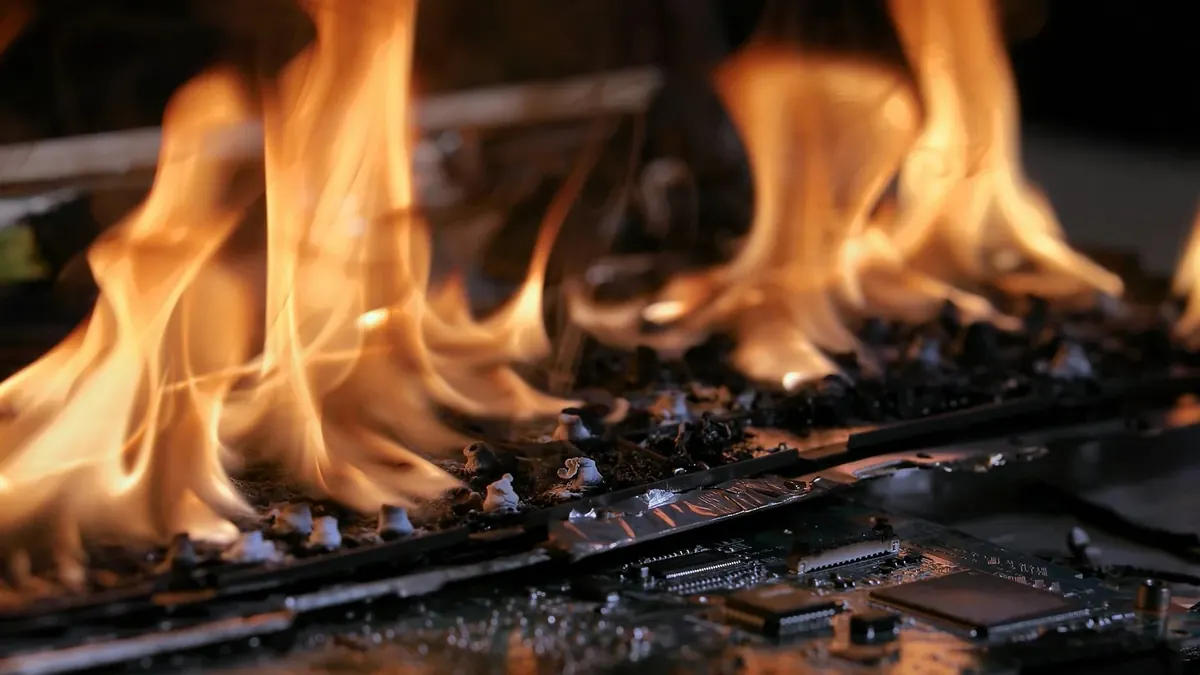
Here's the straight answer. Lithium-ion isn't a letter class on an extinguisher. An ABC can knock down flame you can see. It does not stop a battery in thermal runaway.
What a burning pack needs is cooling and distance. For battery areas, the extinguisher we point people to is F-500. But no handheld is a sure thing on a pack that's gone into runaway. Plan on getting people out and calling 911.
This article is about what to hang before anything happens. If you want what to do while it's burning, read how to put out a lithium battery fire.
What's going on inside a pack
A lithium-ion battery is a bunch of cells packed together. Inside each cell, a thin separator keeps the positive and negative sides apart.
When a cell gets crushed, punctured, overcharged, or overheated, that separator can fail. Sometimes it's just a bad cell from the factory. Either way, the cell shorts inside itself and heats up fast.
That heat breaks down the electrolyte, the liquid inside the cell. It turns into hot gas that's flammable and toxic. The cell swells, vents, and can catch fire. The heat spreads to the cell next to it, and that one goes too. That chain is thermal runaway.
Here's the part that matters for you. The reaction makes its own heat. Covering it or smothering it doesn't stop what's happening inside the cells. A pack can look out and flare back up minutes or hours later.
Why the ABC on your wall won't cut it
An ABC extinguisher throws dry chemical powder. It's good at knocking flames down. On a battery, it can put out the flame on the outside of the pack.
What it can't do is cool the cells inside. The powder coats the case, and the cells under it keep heating. So you get a pack that looks out, then lights back up.
Keep your ABC. It's still what you want for the cardboard, the bench, and the wall behind the charger. Just don't count on it for the battery itself.
Cooling is the whole game
Fire departments put a lot of water on battery fires, and cooling is the reason. Water pulls heat out of the cells and slows the spread from one cell to the next.
F-500 extinguishers are water-based. The agent is mixed into the water to help it soak in and pull heat out faster. That's why it's F-500 by the chargers, not another powder unit.
Be straight with yourself about what it can do, though. A handheld F-500 can help on a small pack caught early, like a tool battery or a laptop. It can't promise that a pack in full runaway stays out. A scooter, an e-bike, or a forklift battery holds a lot of energy. That's a 911 call.
We stock and sell F-500 extinguishers, and we inspect and service them.
When a pack starts smoking
- Get people away from it. The smoke is toxic. Don't stand in it.
- Call 911. Even if you think you've got it handled. It can come back.
- If it's small, and you can move it outside without getting into the smoke, use a shovel or tongs. Set it on concrete or dirt, away from the building. If you can't do that safely, leave it and get out.
- Cool it with water or your F-500, from as far back as you can.
- Keep an eye on it for at least 24 hours. A pack that looks dead can relight.
Where the batteries are in your building
Tool battery chargers. Shops charge packs on a bench, a lot of times right next to rags, cardboard, and solvent. Give the chargers their own spot. A metal shelf or bench, clear of anything that burns.
E-bikes and scooters. People bring them into break rooms, hallways, and apartments and plug them in by the door. That's the exit. If a pack goes, it goes between people and the way out. Charge them away from exits.
Forklifts and fleet equipment. Lithium forklift packs and electric fleet vehicles hold a lot of energy in one place. Charge them in one area, keep that area clear, and make sure everybody knows who calls 911.
Mining equipment. A lot of sites run diesel and electric side by side. One extinguisher type doesn't cover both jobs. More on that in lithium-ion vs. ABC extinguishers.
For all of them: use the charger that came with the battery. Pull swollen, cracked, or damaged packs out of service. Don't leave a pile of packs charging overnight with nobody around. And pick one spot outside where a bad pack can go.
What to hang near the chargers
Here's what we'd tell you on a walk-through:
- An F-500 unit near the charging area, on the way out, not right on top of the charger. You don't want to be reaching over a smoking pack to grab it.
- ABC extinguishers for the rest of the room, same as always.
- A clear path out, with nothing parked in it.
- If it's a whole room full of chargers, or equipment that sits unattended, a handheld may not be enough. For a fixed battery-charging room, we can offer a fixed suppression system. On trucks and equipment, that's vehicle suppression.
Whatever you hang needs to be looked at every month and inspected and serviced like any other extinguisher. We keep the due dates. You don't have to think about them.
For how lithium fits against the letter classes, see classes of fires.
Questions people ask
- What class of fire is a lithium battery?
- None of them. Lithium-ion isn't a letter class on the extinguisher. Treat a lithium pack as its own problem.
- Can you use water on a lithium battery fire?
- Yes. Water is the best thing you've got for cooling it, and you'll need a lot. It may not stop it on the spot, but cooling is what keeps the heat from spreading cell to cell.
- Do I need a lithium extinguisher at home for my e-bike?
- It's not a bad idea. What matters more is how you charge it. Use the charger it came with, keep it away from the door, and don't charge it overnight while everybody's asleep. If it catches, get out and call 911.
- Does an F-500 need the same service as my other extinguishers?
- Yes. It's an extinguisher on your wall. It gets looked at every month and inspected and serviced on schedule.
Tell us where the batteries are
Call 1-800-348-9604. Tell us where the batteries are and how they get charged. We'll walk it and tell you what to hang. We sell, hang, inspect, and service extinguishers, including F-500.