
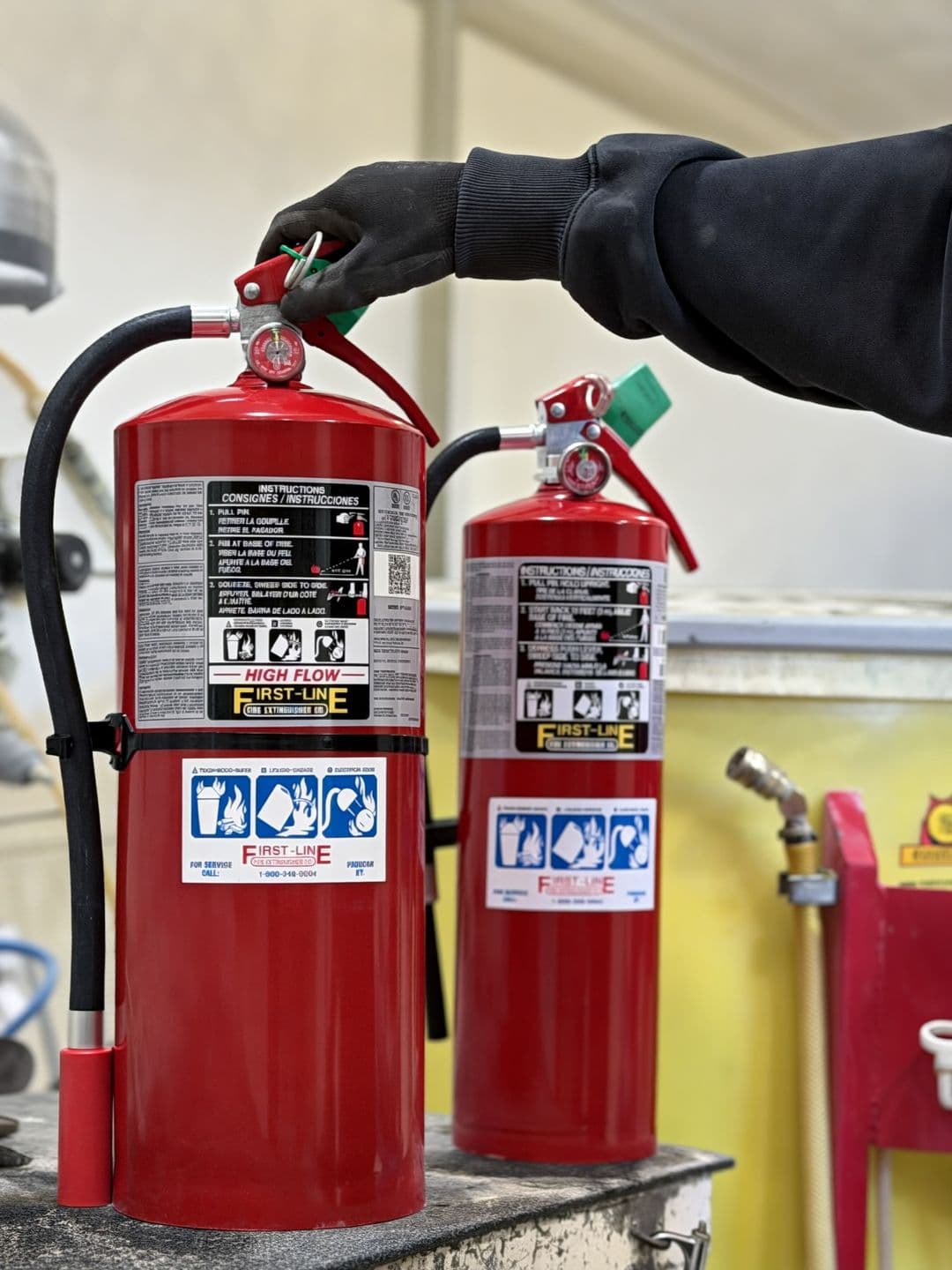
A fire extinguisher isn't regular trash. It's a pressurized cylinder with agent inside. Throw one in a dumpster and the hauler or the landfill can get a surprise nobody asked for — a discharge, a flying part, or a mess of dry chemical. That's why disposal is its own question, not just "take it out with the cardboard." A plant or shop that piles old cans behind the building is still stuck with the same problem — they're pressurized until someone empties them the right way.
This is for Henderson businesses — plants, shops, churches, offices, property managers — swapping out units that are used, failed, or past their useful life. Henderson is on our Madisonville shop's route. The techs drive over from West Noel Avenue. Call 1-800-348-9604 when you're ready.
First: does it actually need to go?
Not every old-looking extinguisher is ready for the scrap pile. Some need a recharge. Some need a hydro test. Some are done. The first job is to tell those apart before anyone starts hauling cans to the curb.
It usually needs to come off the wall when:
- It's been used, even once. Any discharge means a recharge — or a replacement if the unit isn't built for one.
- It failed a hydro test, or the test is due and the cylinder isn't worth keeping.
- The shell is dented, rusted, or the valve is damaged.
- It's a disposable unit (usually a plastic valve) that's past its life.
- The hazard changed, and the type on the wall is no longer the right match.
A unit that still holds pressure, still passes a walk-up check, and still matches the hazard may only need service — not disposal. Pulling a good cylinder for no reason costs you a replacement you didn't need.
Most rechargeable extinguishers don't carry an expiration date the way milk does. They're retired when they fail a test, get damaged, or can't be serviced. More on whether fire extinguishers expire. A failed hydro test is one reason a cylinder leaves the building for good — more on hydro testing. If the hydro is due and the shell is already beat up, replacement often beats paying to keep it.
Rechargeable or disposable
The valve tells you a lot. A metal valve and a gauge usually mean a rechargeable unit. A plastic valve usually means disposable — it can't be recharged, and when it's done, it gets replaced.
A rechargeable extinguisher that still passes inspection may not need disposal at all. It gets recharged, put back on the wall, and stays on the calendar. That's the cheaper path when the cylinder is sound.
Don't cut one open, drill it, or try to refill it yourself. Pressurized agent and a valve that wasn't meant for DIY work are a bad mix. More on why you shouldn't refill an extinguisher yourself.
Why disposal is a tech job for commercial units
Commercial extinguishers have to be depressurized and emptied before the cylinder can go to scrap. The agent and the empty shell aren't the same kind of waste. Dry chemical, CO2, wet chemical, and clean agent are all handled as pressurized equipment first — empty them wrong and you've made a bigger problem than the one you started with.
That's work for a tech, not a dumpster and not a torch. We take commercial units that are coming off the wall when we replace them, and we haul them off for disposal and recycling. We empty them and scrap the cylinders. If you're already on the route, leave the old ones for the visit — no need to stack them by the dock for someone else to guess at.
A Henderson business can also drop commercial units at the Madisonville shop on West Noel Avenue. Bring what you have; we'll take it from there.
We don't take homeowner or disposable household units. For those, a household hazardous waste or recycling drop-off is the usual path — check what your local program accepts before you load the car. We stay out of naming a specific city program here, because those rules change.
Put the right one back up
Disposal without replacement leaves a blank spot on the wall. Match the new extinguisher to the hazard in that spot — kitchen, electrical room, shop floor, warehouse aisle — install it where people can reach it without moving a pallet, and get it on the schedule so it's inspected and serviced from then on.
We sell, install, inspect, and service extinguishers. Our trucks carry loaners — if a cylinder has to ride back to the shop, a loaner goes up in that spot until yours is back. 24-hour service covers a unit that was just discharged and needs a replacement now. The full picture of how we handle fire extinguishers is on that page.
Henderson, from Madisonville
Henderson stays with the Madisonville shop. Evansville goes to Princeton; Henderson does not. The truck that shows up is coming from West Noel Avenue. Our techs are certified and licensed.
When we replace units on a Henderson visit, we take the old commercial extinguishers with us and haul them off. Same if you drop them at the shop — commercial units only. You shouldn't have to keep the date. We do.
Call 1-800-348-9604. Tell us what's on the wall and what needs to come down. We'll get you on the calendar.