
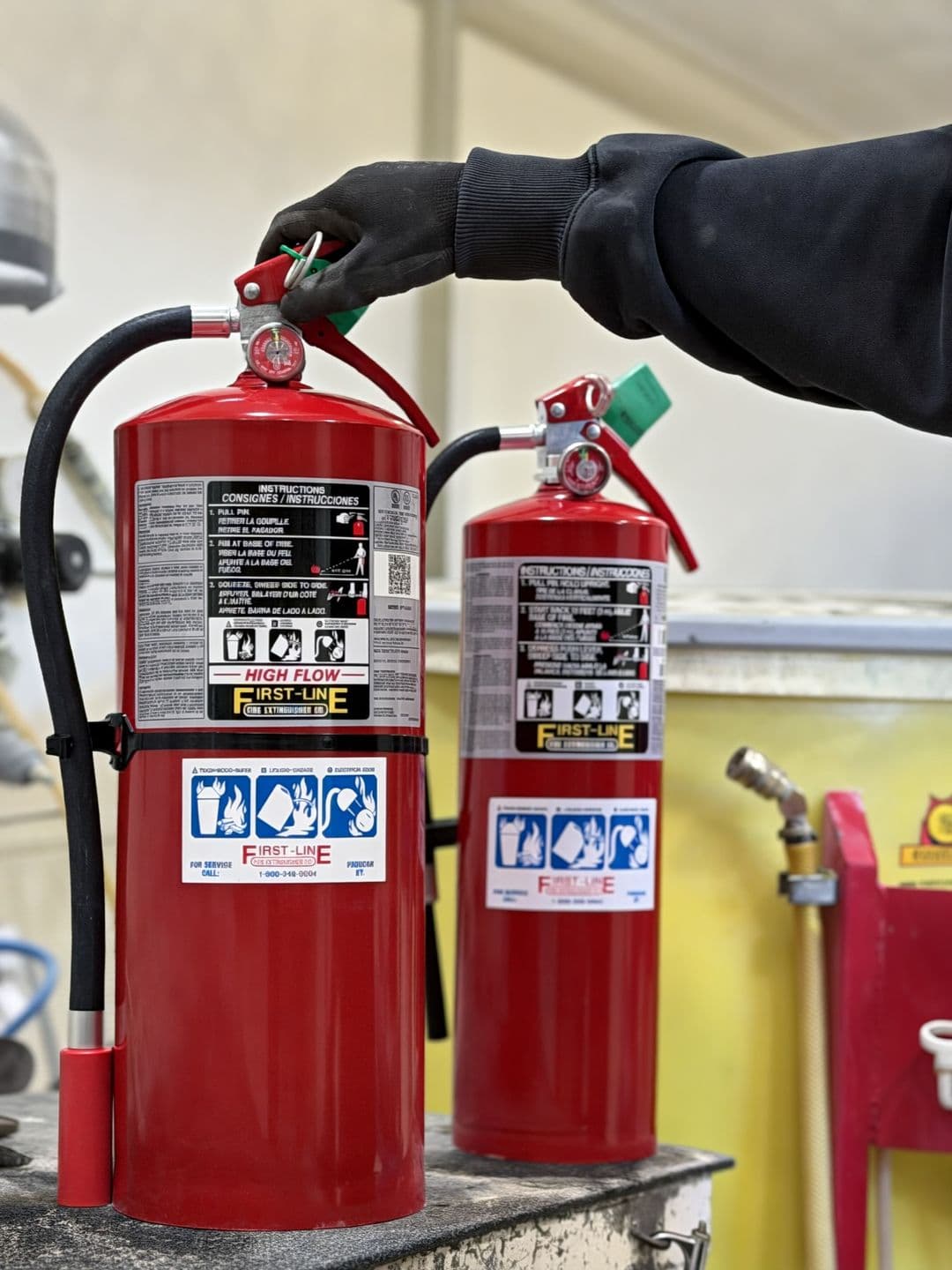
Here's the short answer first. Then the part most people get wrong.
The short answer
NFPA 10 is the standard for portable fire extinguishers. Your fire marshal and your insurance company go by it, and OSHA's workplace rules line up with it. Here's the schedule it sets for a typical business extinguisher:
- Every month: a quick look. You can do this one yourself.
- Every year: annual maintenance by a trained tech.
- Every 6 years: internal maintenance on stored-pressure dry chemical extinguishers. That's the ABC on most walls.
- Every 5 or 12 years: a hydrostatic test on the cylinder, depending on the type.
- Any time it's used: recharge or replace it before it goes back on the wall.
That's the whole list. What trips people up is what each one actually involves.
What the monthly look covers
This is the one you can do. It doesn't take long.
Walk to each extinguisher and check that:
- It's where it's supposed to be.
- Nothing's blocking it or stacked in front of it.
- The pin is in and the tamper seal isn't broken.
- The gauge needle is in the green.
- There are no dents, rust, leaks, or cracked hoses.
- The instructions face out, where somebody can read them.
Then write down that it was checked and who checked it.
If anything's off, take that one out of service and call.
The annual visit is hands-on work
The annual isn't somebody glancing down the hallway and writing a new date. A trained tech handles every extinguisher.
That means everything on the monthly list, plus:
- Weighing the ones that need it. CO2 extinguishers don't have a gauge, so weight is the only way to know what's in them.
- Checking the hose, nozzle, and valve for cracks, damage, and anything built up inside.
- Looking at the cylinder and label up close.
- Making sure it's the right type for what's around it. An ABC doesn't belong next to a deep fryer.
- Opening up cartridge-operated extinguishers to check the agent and the cartridge.
- Seeing whether 6-year work or a hydro test is coming due.
We leave a report.
If you want the longer version of what good service looks like, we wrote it up here: fire extinguisher inspection.
The 6-year job
The ABC extinguisher on most walls is stored-pressure dry chemical. The powder and the pressure sit together in the cylinder. Over the years, the powder packs down from vibration and can pick up moisture. Seals age. The gauge can read fine while the powder inside won't flow the way it should.
So every 6 years, it gets opened up. Here's the job:
- Discharge it.
- Take the valve off.
- Look inside the cylinder.
- Replace the valve stem O-ring.
- Put in new agent.
- Recharge it.
Then a new verification collar ring goes on under the valve. That ring can only go on with the valve off. It's your proof the work got done.
If the ring is missing, cut and taped, or stretched over the handle, somebody skipped the job. And skipping it usually doesn't cost you any less.
Hydrostatic testing
A hydro test checks whether the cylinder can still hold pressure safely. The cylinder is emptied, filled with water, and pressurized well past what it holds in normal use. The tech watches for leaks, bulges, and permanent stretch. A cylinder that fails is done. It doesn't go back in service.
Why water? Because water barely compresses. There's very little stored energy in a water-filled cylinder. If a weak one lets go during the test, it splits instead of blowing apart.
How often depends on the type:
- Every 5 years: water, wet chemical (Class K), CO2, and foam extinguishers.
- Every 12 years: dry chemical and clean agent extinguishers.
When a cylinder comes due, we pull it, test it, and bring it back. More on that here: hydro testing.
After it gets used
Any discharge counts. A one-second squeeze. A test shot. Somebody bumping the handle. Once it's been used, it comes off the wall until it's recharged or replaced. The gauge might still read fine. That doesn't mean there's enough left for the next fire.
A recharge should leave a new verification collar ring under the valve.
The longer version is here: how long does a fire extinguisher last once used.
Kitchens, boats, trucks, and mines have extra rules
The schedule above is for portable extinguishers in a building. Some places answer to more than that.
- A kitchen hood system is on its own schedule, separate from the extinguishers. It gets inspected and serviced every six months.
- Commercial boats have Coast Guard rules on top of NFPA 10.
- Mines answer to MSHA.
- Some sites use Avetta, which has its own paperwork.
- Your local fire marshal can ask for more.
We work to OSHA and what the local fire marshal wants to see.
Who keeps track of all this?
Monthly. Yearly. Six years. Five or twelve. Across every extinguisher in the building, each one on its own clock. That's a lot to keep straight on top of running a business.
That's the job we take off your plate. We keep the due dates. You don't have to think about them.
Questions people ask
- Can our maintenance guy do the annual inspection?
- He can do the monthly look. The annual maintenance is a job for a trained tech. All of our techs are certified and licensed.
- Do fire extinguishers expire?
- Most rechargeable extinguishers don't have an expiration date. They have a schedule. As long as one keeps passing its annuals, 6-year work, and hydro tests, it stays in service. It gets retired when it fails a hydro test, gets damaged, or can't be serviced anymore. Disposable extinguishers can't be recharged, so they get replaced instead.
- What happens if we skip the monthly checks?
- The fire marshal can write it up. Worse, you might not find out an extinguisher is empty until you need it.
- What does the fire marshal look at?
- They check the last inspection date, the gauge and the pin, and the travel distance to the next unit. Here's the rest: fire marshal inspection checklist.
- Do you do the monthly checks for us?
- If you want us to. We'll walk the floor every month so your people don't have to.
Want somebody else to keep track?
Call 1-800-348-9604. Tell us where your extinguishers are and roughly how many. We'll get you on the calendar.
You shouldn't have to keep the date. We do.