MADISONVILLE · KY
Kitchen Hood Suppression Inspection in Madisonville, KY
You shouldn't have to keep the date. We do.
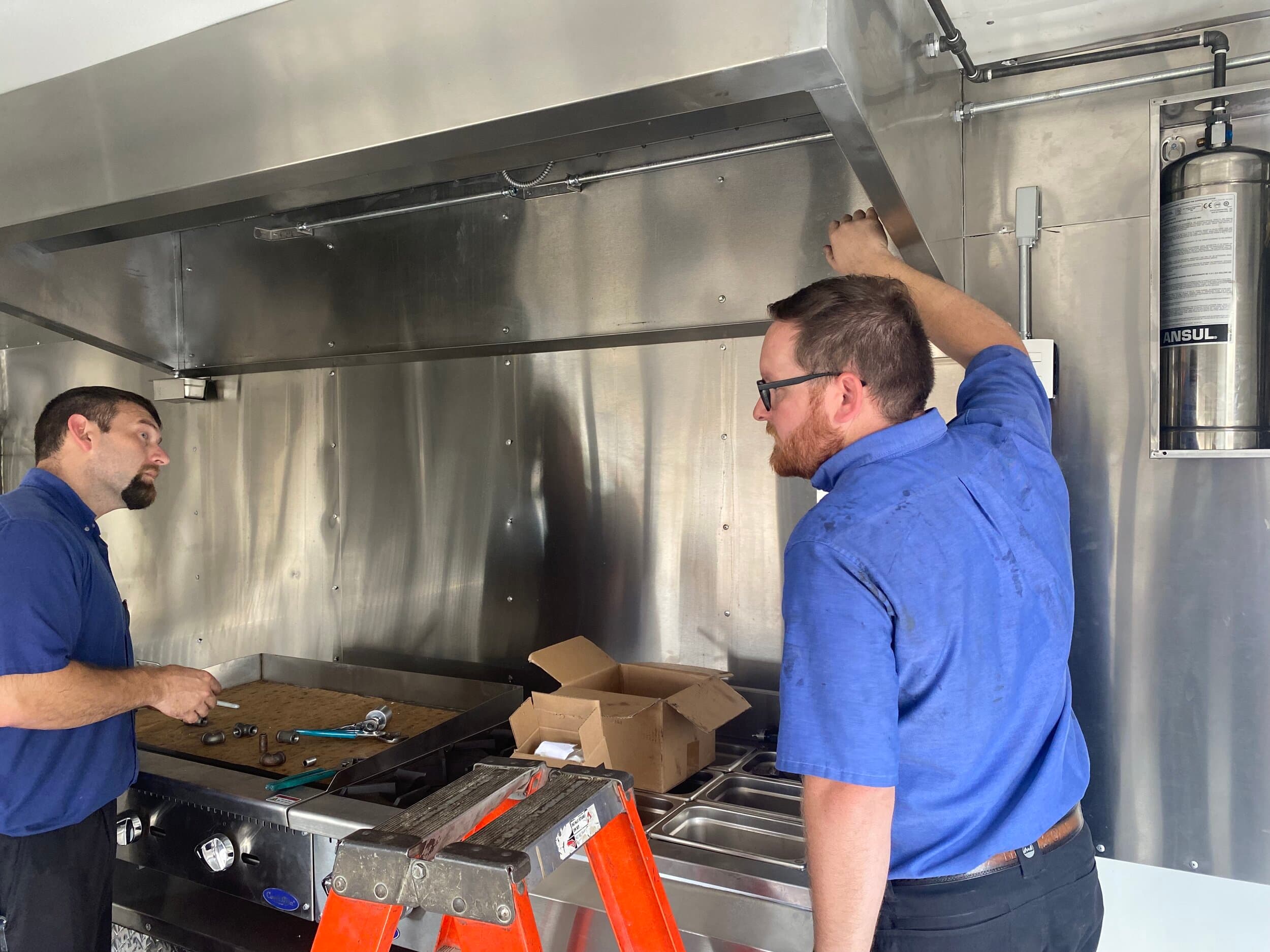
If you cook with grease under a hood, there's a fire suppression system up there. Most days nobody thinks about it. Then the fire marshal walks in, or the insurance company calls, and they want proof the hood system isn't past due for service.
We inspect and service kitchen hood systems out of our Madisonville shop at 1503 West Noel Avenue. The Class K extinguisher next to the line gets done on the same visit.
So what's actually up in that hood?
It's worth knowing how it works, because that's why the service matters.
A cable runs across the hood, over the cooking appliances. Along that cable are fusible links. Those are small metal links held together with solder that melts at a set temperature. When a grease fire gets going, the heat melts a link. The cable goes slack and trips the release.
The release lets gas from a cartridge push the wet chemical out of its tank. The agent runs up the pipe and out the nozzles. There's a nozzle aimed at each appliance, plus nozzles in the hood and up in the duct.
At the same time, the gas to the cook line shuts off. On electric equipment, the power shuts off.
The wet chemical does two things. It reacts with hot grease and turns the top of it into a soapy layer that holds the fire down. And it cools the grease so it doesn't flash back up.
Every one of those parts has to work, in order, the one time you need it.
Here's what the tech checks
- The links. Grease builds up on them and changes how they react to heat. We replace them at every service.
- The nozzles. Each one has to be clear, capped, and pointed at the right appliance. Grease-packed nozzles and missing caps are common.
- The appliances under them. If somebody slid the fryer down a spot or added a griddle, the nozzles may not cover it anymore. We check that the line still matches the system.
- The tank and cartridge. Pressure, weight, and condition.
- The trip test. With the cartridge out so nothing discharges, we trip the system and make sure the release works and the gas valve actually closes. We do that on every hood service.
- The pull station. It has to be there, easy to reach, and on the way out of the kitchen, not behind a rack.
- The alarm tie-in, if the system is hooked to the building's fire alarm.
Then it gets reset and sealed. Between meals is easiest, but we can work while you're cooking. We don't shut you down.
Don't forget the K next to the line
A hood system needs a Class K extinguisher close to the cook line. Class K is wet chemical too. It's the same agent idea as the hood, in a hand unit.
Here's the part people get backwards. Pull the station first. Let the system go. Then use the K if there's still fire. The K backs up the hood. It doesn't replace it.
The rest of the kitchen, the office, and the dining room usually get ABC extinguishers. We inspect and service all of them on the same visit as the hood.
How often does it have to be done?
A kitchen hood system gets inspected and serviced every six months. The fire marshal wants proof. Your insurance company wants proof. Some landlords and franchise owners want it too.
We leave a report. After that, we keep the due dates. You don't have to think about them.
Kitchens all over Hopkins County
Madisonville is the Hopkins County seat, and there's plenty of cooking here. Restaurants along Main Street and out by the interstate exits. The hospital kitchen. School cafeterias. Nursing homes. Church fellowship halls with a real hood over the stove. Out in Dawson Springs, Earlington, and Nortonville, the kitchens are smaller, but the hood still has to work.
From the same shop we work kitchens in Henderson, Owensboro, Hopkinsville, and Clarksville, Tennessee. We service all makes of hood systems.
Still got an old dry chemical system up there?
Older hood systems used dry chemical. They were built before today's cooking oils, which burn hotter and hold heat longer. UL 300 is the fire test kitchen systems are held to now, and most old dry chemical systems weren't built to pass it. A system that isn't UL 300 has to be replaced.
Not sure what's up there? We'll tell you when we look. More on the difference here: wet chemical vs. dry chemical.
If it goes off
Once a hood system discharges, you can't cook under it until it's recharged and back in service. Call us. We recharge it and get the line going again. After-hours emergency service is available.
The agent leaves a soapy film on the appliances. It has to be cleaned off before you cook.
Madisonville kitchen questions
- Is hood cleaning the same as a suppression inspection?
- No. Hood cleaning gets the grease out of the hood and duct. A suppression inspection makes sure the fire system works. You need both. We don't do hood cleaning. That's a job for a hood cleaning company. We take care of the suppression system.
- Can you do the extinguishers on the same visit?
- Yes. The Class K by the line and the ABCs around the kitchen.
- We moved our fryer. Does that matter?
- Yes. The nozzles are aimed at where the appliances used to be. Call us before the fire marshal finds it.
- Our system went off. What now?
- Don't cook under it. Call 1-800-348-9604. We'll recharge it and get it back in service.
Get your hood on the calendar
Call 1-800-348-9604. Tell us where the kitchen is and what's cooking under the hood. We'll get you scheduled. Or send it through the contact page.
Free quote
Tell us what you need.
Name, phone, email, company / site name, and what you need. It goes to sales@firstlinefire.com.